 Chat with us

Why the Ascending Triangle Is One of the Best Triangle Patterns to Trade
- Jun 15
- 9 min read
In trading, the best chart patterns are not the ones that look impressive after the move is over. The best patterns are the ones that help you make clear decisions before the move happens.
That is one reason the ascending triangle is so popular among traders. It gives a trader three important things: a clear breakout level, a logical stop-loss area, and a structure that shows buying pressure building over time.
The ascending triangle is often considered a bullish continuation pattern, especially when it forms during an existing uptrend. It does not guarantee a breakout, but it gives traders a clean framework to understand supply, demand, risk, and opportunity.

What Is an Ascending Triangle?
An ascending triangle is a chart pattern formed when price keeps testing a similar resistance level while also making higher lows.
It usually has three main parts:
Flat or nearly flat resistance
Rising trendline support
Higher lows showing increasing buying pressure
The resistance line shows an area where sellers are repeatedly active. Each time price reaches that level, sellers try to stop the move.
But the important part is what happens after each rejection.
Instead of falling deeply, price starts bouncing from higher levels. This creates a rising support line. Buyers are stepping in earlier each time, showing that demand is becoming stronger.
This creates price compression. Price gets squeezed between the flat resistance above and the rising support below. Eventually, that pressure often leads to a breakout.
The Psychology Behind the Pattern
The ascending triangle works because it shows a clear battle between buyers and sellers.
Sellers are defending one level, for example, ₹100 or $100. Every time price reaches that level, sellers come in and push it down.
But buyers are becoming more aggressive.
The first pullback may come down to 90. The next pullback may only reach 94. The next one may stop at 97. This means buyers are no longer waiting for a deep discount. They are willing to buy at higher and higher prices.
That is the key message of the pattern.
The resistance level shows supply. The higher lows show demand. When demand keeps rising while supply remains fixed, pressure builds. If buyers finally absorb the sellers at resistance, price can break out strongly.
This is why many traders see the ascending triangle as a sign of accumulation. It may suggest that stronger hands, including institutions or serious market participants, are quietly building positions before a breakout.
Why Traders Like the Ascending Triangle
The ascending triangle is popular because it gives traders structure. It helps remove guesswork.
1. It Has a Clear Breakout Level
One of the biggest advantages of the ascending triangle is the flat resistance level. Traders know exactly where the pattern becomes interesting.
If resistance is at 100, then a breakout above 100 becomes the key signal.
This is easier to trade than patterns where the breakout level is unclear or constantly shifting.
2. Stop-Loss Placement Is Easier
A good trade is not only about where to enter. It is also about knowing where the idea is wrong.
In an ascending triangle, traders often place their stop-loss:
Below the rising trendline
Below the most recent higher low
Below the breakout candle after confirmation
This gives the trade a logical invalidation point. If price breaks down through support instead of breaking out above resistance, the pattern has failed.
3. It Offers Defined Risk and Reward
The pattern also helps traders estimate potential reward.
A common method is to measure the height of the triangle from the lowest support point to the resistance level. That distance is then projected above the breakout level.
For example, if the base of the triangle is at 90 and resistance is at 100, the height is 10 points. A breakout above 100 may give a projected target near 110.
This does not mean price must reach 110. It simply gives traders a reasonable reference point for planning the trade.
4. It Works Well in Trending Markets
Ascending triangles are strongest when they appear during an existing uptrend.
In that situation, the pattern often represents a pause before the trend continues. Price moves up, consolidates in a controlled way, forms higher lows, and then attempts to break out again.
This is why the ascending triangle is usually viewed as a bullish continuation setup.
5. It Shows Accumulation
The rising lows suggest buyers are gradually gaining control. When price refuses to fall much after touching resistance, it shows strength.
This can be a sign that larger buyers are accumulating shares. They may not chase the price aggressively at first, but they continue to absorb supply on every small dip.
When sellers at resistance are finally exhausted, the breakout can become powerful.
6. It Helps Avoid Random Trades
Many traders lose money because they trade without structure. They enter because price “looks strong” or because they feel they might miss the move.
The ascending triangle gives a trader a process:
Identify resistance
Watch for higher lows
Wait for compression
Confirm breakout
Manage risk
That structure helps traders stay disciplined.
How to Trade an Ascending Triangle
Here is a simple step-by-step method for trading the ascending triangle.

Step 1: Identify the Pattern
Look for price repeatedly testing a similar resistance level while forming higher lows.
The resistance does not need to be perfectly flat, but it should be clear enough that many traders can see it.
A good ascending triangle should have:
At least two touches near resistance
At least two higher lows
Price getting tighter over time
A clear support trendline rising underneath price
Step 2: Check the Market Context
The pattern works best when the broader market or sector is supportive.
A bullish pattern in a weak market can fail easily. Before trading, ask:
Is the stock already in an uptrend?
Is the broader market healthy?
Is the sector showing strength?
Is the stock outperforming similar stocks?
A strong setup in a weak environment needs extra caution.
Step 3: Watch Volume and Price Tightness
Volume can help confirm the quality of the setup.
Ideally, volume becomes quieter during the consolidation phase. This shows that selling pressure may be drying up. Then, on the breakout, volume should expand as buyers step in aggressively.
Tight price action is also useful. If the stock is forming controlled higher lows and not making wild swings, the pattern is usually cleaner.
Step 4: Wait for Breakout Above Resistance
The most common mistake is entering too early.
A proper breakout happens when price moves above resistance with strength. Ideally, the breakout should be supported by strong volume and a decisive candle close above the resistance level.
Some traders enter immediately on the breakout. Others wait for the price to close above resistance before entering.
The more conservative approach is to wait for confirmation.
Step 5: Enter on Breakout or Retest
There are two common entry methods.
Breakout entry:The trader enters when price breaks above resistance.
This can capture the move early, but it carries the risk of a false breakout.
Retest entry:The trader waits for price to break out, then come back and retest the old resistance as new support.
This can offer a better risk-reward entry, but sometimes the stock does not retest and continues moving higher without you.
Neither method is perfect. The best choice depends on your trading style.
Step 6: Place the Stop-Loss
A stop-loss should be placed where the trade idea is invalidated.
Common stop-loss areas include:
Below the breakout level
Below the rising trendline
Below the most recent higher low
For example, if resistance is at 100 and the last higher low is at 97, a trader may place the stop slightly below 97. If price falls below that level, the pattern has lost its strength.
Step 7: Set a Target
A simple target method is to measure the height of the triangle.
Example:
Resistance: 100
Lowest low in the triangle: 90
Height: 10 points
Breakout level: 100
Projected target: 110
This gives a practical target area. Traders may also use previous resistance zones, moving averages, or trailing stops to manage the trade.
Example of an Ascending Triangle Trade
Imagine a stock is in an uptrend and then starts consolidating.
It repeatedly struggles to move above 100. Each time price reaches 100, sellers appear.
But the pullbacks are becoming smaller:
First pullback: 90
Second pullback: 94
Third pullback: 97
This shows that buyers are stepping in earlier each time. The stock is no longer falling back to 90. Buyers are now willing to buy near 94 and then near 97.
The resistance remains at 100, but the support keeps rising.
Eventually, price breaks above 100 with strong volume and closes at 103.
A trader may enter near the breakout or wait for a retest of the 100 level. A possible stop-loss could be placed below 97 or below the breakout level, depending on the trader’s risk tolerance.
Using the height of the pattern:
Resistance: 100
Lowest support: 90
Pattern height: 10
Breakout target: 110
The trader now has a structured trade plan: entry, stop-loss, and target.
That is what makes the ascending triangle useful. It turns a chart pattern into a decision-making framework.
Ascending Triangle vs Other Triangle Patterns
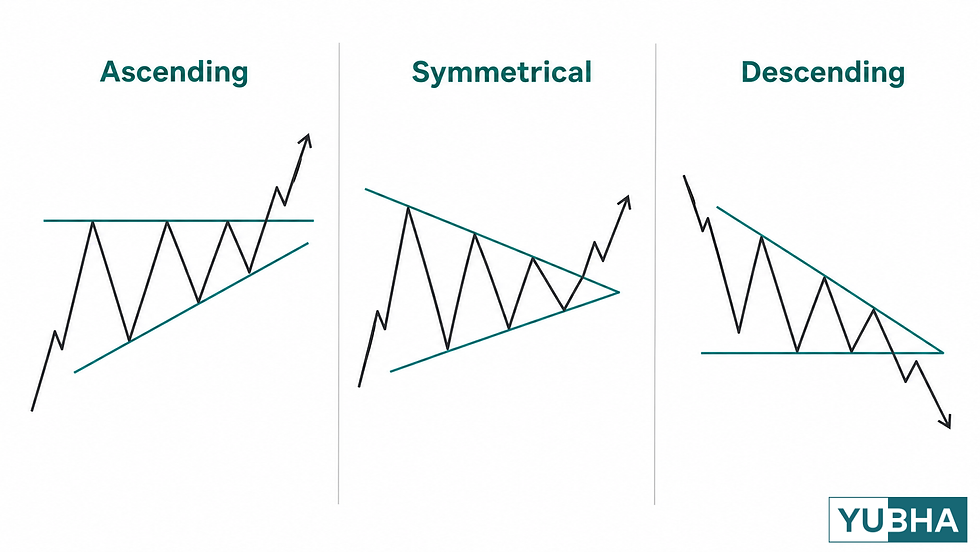
There are three common triangle patterns traders watch:
Ascending triangle
Symmetrical triangle
Descending triangle
Each pattern can be useful, but the ascending triangle is often easier for bullish traders to understand and execute.
Ascending Triangle vs Symmetrical Triangle
A symmetrical triangle forms when price makes lower highs and higher lows. The range contracts from both sides.
The problem is that direction is less clear. Price can break upward or downward. Until the breakout happens, the pattern is more neutral.
An ascending triangle, on the other hand, shows a more obvious bullish bias because buyers are making higher lows while sellers are defending the same resistance.
That does not mean the ascending triangle always breaks upward, but the psychology is clearer.
Ascending Triangle vs Descending Triangle
A descending triangle is usually considered bearish. It forms with flat support and lower highs.
In that pattern, sellers are becoming more aggressive. They are willing to sell at lower and lower prices, while buyers are trying to defend the same support level.
This is the opposite of an ascending triangle.
For traders looking for bullish continuation setups, the ascending triangle is usually more attractive.
Ascending Triangle vs Random Consolidation
Not every sideways move is a pattern.
Random consolidation may have no clear resistance, no rising support, and no obvious pressure building. Price may simply be moving sideways without direction.
The ascending triangle is different because it shows organized compression. Buyers are clearly stepping in at higher levels, while resistance remains visible.
That structure makes it easier to plan a trade.
Common Mistakes Traders Make
Even though the ascending triangle is a useful pattern, traders often misuse it.
1. Entering Before the Breakout
Many traders enter too early because they want to catch the move before everyone else.
The problem is that the pattern is not confirmed until price breaks resistance. Before that, the stock can still fail, move sideways, or break down.
Early entries can work, but they require more experience and tighter risk control.
2. Ignoring Volume
A breakout without volume can be weak.
Volume shows participation. If price breaks above resistance but volume is low, the breakout may not have enough demand behind it.
Strong volume does not guarantee success, but it adds credibility.
3. Drawing Poor Trendlines
Forcing a pattern onto a chart is dangerous.
A valid ascending triangle should be obvious. If you have to adjust the lines too much or ignore several price points to make it fit, the pattern may not be reliable.
Good patterns are usually clear without too much imagination.
4. Trading in Weak Market Conditions
Even strong patterns can fail in weak markets.
If the overall market is selling off, bullish breakouts are more likely to fail. The best ascending triangles usually appear when the broader market, sector, and stock are aligned.
5. Using Too Large a Position Size
A clean pattern does not remove risk.
Some traders become overconfident and take a position that is too large. When the breakout fails, the loss becomes emotionally and financially damaging.
Position size should always be based on the distance between entry and stop-loss.
6. Not Waiting for Confirmation
A small move above resistance is not always a real breakout.
Sometimes price briefly moves above resistance, attracts buyers, and then quickly falls back below the breakout level. This is called a false breakout.
Waiting for a candle close, strong volume, or a successful retest can help reduce this risk.
Risk Management Comes First

No chart pattern works 100% of the time.
The ascending triangle is powerful because it gives structure, not certainty. Traders still need to manage risk carefully.
Before entering any trade, decide:
Where will I enter?
Where is my stop-loss?
What is my target?
How much money am I willing to risk?
Is the market environment supportive?
What will I do if the breakout fails?
A good trader does not depend on prediction alone. A good trader prepares for different outcomes.
Final Thoughts
The ascending triangle is one of the best triangle patterns to trade because it shows a clear shift in pressure. Sellers are defending resistance, but buyers are becoming more aggressive with every higher low.
Compared with a symmetrical triangle, the bullish message is clearer. Compared with a descending triangle, it is better suited for traders looking for upside continuation. Compared with random consolidation, it gives a cleaner structure for planning entries, exits, and risk.
But the real advantage of the ascending triangle is not that it predicts the future perfectly. Its advantage is that it helps traders think clearly.
It shows where buyers are active. It shows where sellers are defending. It shows where the breakout level is. And most importantly, it gives traders a way to define risk before entering the trade.
“The ascending triangle is not powerful because it guarantees profits. It is powerful because it gives traders a clear structure, visible pressure, and a disciplined way to manage risk.”


Comments